A rescue diver course in Hurghada turns a certified diver who reacts calmly into one who reacts correctly, and the difference matters the moment a buddy panics at 12 meters. This guide breaks down what to look for, which add-on dives actually build the skill, and what to skip before you commit your 2026 dive dates to a rescue program in the Red Sea.
- A rescue diver course in Hurghada requires an Advanced Open Water certification and current CPR/first aid training before you start.
- Pair rescue training with a wreck or night dive add-on to practice stress management in real conditions, not a pool.
- Skip operators that compress rescue scenarios into a single afternoon; the course needs open-water repetition to stick.
- Daily Red Sea's certified diver programs and advanced course pages are the right starting point for prerequisites.
Why this matters
Rescue training is the one certified-diver course that changes how you dive every time after, not just on the day you take it. It teaches you to spot early signs of trouble in a buddy - erratic breathing, task fixation, silent stress - before a small problem becomes a real one. In Hurghada's Red Sea sites, where currents at reefs like Giftun and Abu Ramada can shift fast, that skill set has practical value beyond the certification card.
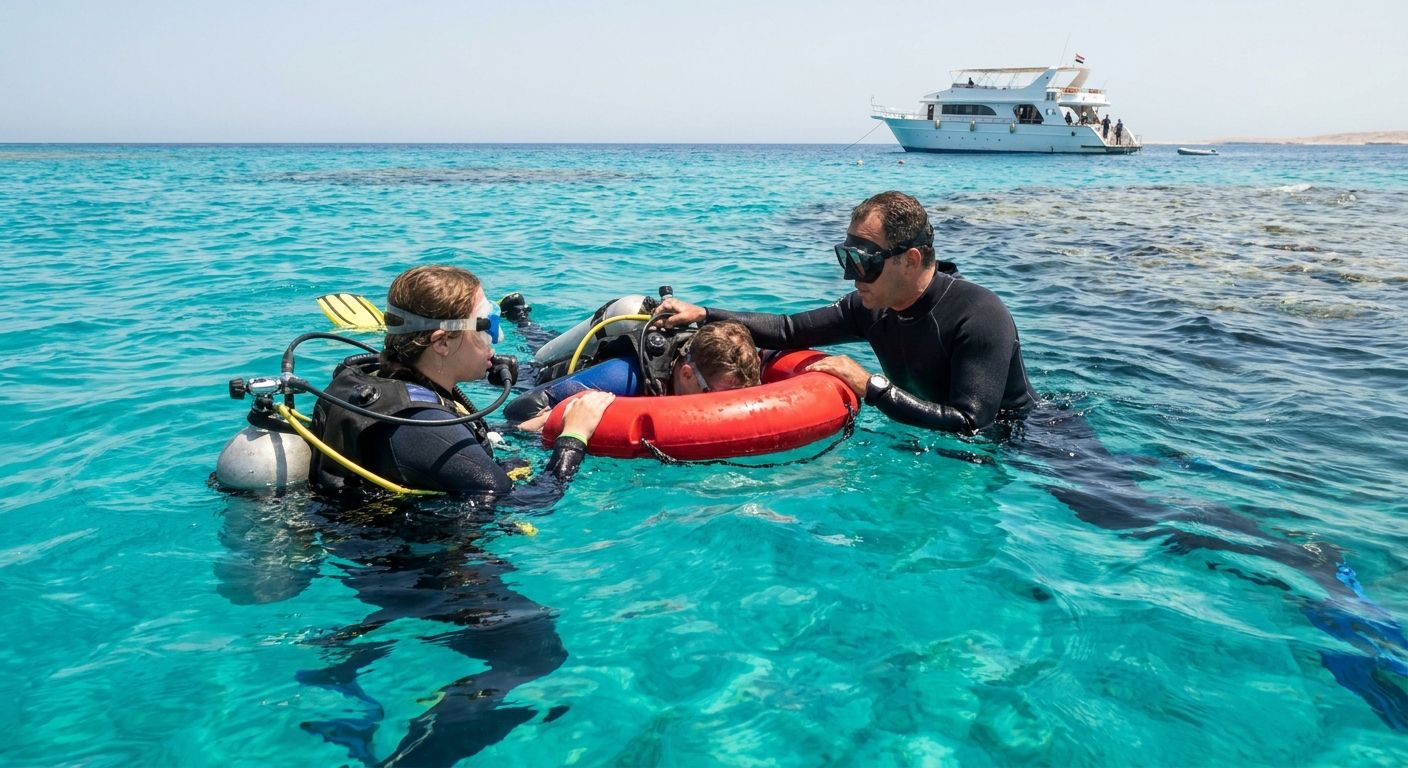
Most divers taking this course already hold an Advanced Open Water certification and have logged dives beyond their initial 4-8. The course itself blends classroom scenarios, confined-water practice, and open-water rescue simulations - missing person searches, panicked diver response, unresponsive diver tows. It is physically and mentally demanding in a way Open Water and Advanced courses are not.
Who this is for
This course fits certified divers who already hold an Advanced Open Water Diver course certification or equivalent, have current CPR/first aid training within the last 24 months, and want to move toward Divemaster or simply dive with more confidence as a buddy. It is not an entry point - if you are still building basic buoyancy control, a scuba diving course for certified divers or refresher dive in Hurghada should come first.
What to look for in a rescue diver course for certified divers
Prerequisite verification, not just a form
A properly run rescue course checks your Advanced Open Water certification and CPR/first aid currency before day one, not after you've paid. If an operator lets you sign up without asking for proof of prior certification dates, that's a red flag on how seriously they treat the standard.
Real open-water rescue scenarios
Pool sessions teach the mechanics, but open water is where rescue skills actually get tested against current, visibility, and fatigue. A course that runs its unresponsive-diver and panicked-diver scenarios only in a shallow lagoon skips the part that matters most for real Red Sea conditions.
Small class ratios
Rescue training depends on instructor attention during high-stress simulated scenarios. A class of 6-8 students per instructor means less individual coaching on technique like the tired-diver tow or in-water rescue breathing.
Emergency response integration
The course should fold in EFR-style first aid and CPR review, not treat it as a separate module you already did years ago. Currency matters here because rescue breathing and CPR technique changes over time.
Dive site variety during training
Running every scenario at the same shore-access site limits what you practice. Courses that use a boat day at a reef site alongside a shallow bay session expose you to more realistic search patterns and surface conditions.
Logged dive count going in
PADI does not mandate a strict minimum dive count for Rescue Diver, but most operators recommend at least 20 logged dives before starting - enough that basic skills like buoyancy and mask clearing are automatic, freeing attention for the rescue scenario itself.
Check rescue course prerequisites
Confirm certification level and get pickup details before you book.
Top picks for building toward or around your rescue course
The prerequisite check - Advanced Open Water Diver course in Hurghada. This is the certification gate for Rescue Diver, covering five adventure dives including deep and navigation skills. If you're missing this, start here before booking rescue training. Buy.
The stress-test add-on - wreck diving trips for advanced divers. Wreck sites near Hurghada add current, reduced visibility, and overhead-environment awareness that push rescue skills past pool-level comfort. Pairing a wreck dive with rescue training in the same trip week sharpens situational awareness fast. Consider.
The low-light scenario builder - night diving trips for experienced divers. Reduced visibility at night forces you to rely on buddy checks and light signals, which mirrors the communication breakdown scenarios rescue training simulates. Not a replacement for daylight rescue practice, but a useful supplement after certification. Consider.
The certified-diver refresher - scuba diving for certified divers in Hurghada. If your last dive was more than six months ago, a refresher dive before rescue training rebuilds muscle memory on basic skills so class time goes toward rescue-specific work instead of catching up. Buy if it's been a while.
The certification pathway check - how to get PADI certified while in Hurghada. Useful if you're unsure which certification track you're on or need to confirm your paperwork lines up with PADI's rescue prerequisites before booking. Consider.
What to avoid
- One-day "crash course" rescue certifications. Rescue Diver standards call for multiple scenario types across confined and open water; compressing everything into a single afternoon means you're getting a card, not the skill.
- Operators that skip the CPR/first aid currency check. If nobody asks when you last completed CPR training, the course isn't verifying a real prerequisite - it's selling a certificate.
- Rescue training bundled with unrelated fun dives as filler. A rescue course padded with recreational reef time to hit a multi-day package isn't giving you more scenario repetition, just more days on the calendar.
Verdict comparison
| Option | Best for | Key requirement | Verdict |
|---|---|---|---|
| Advanced Open Water course | Missing prerequisite | 5 adventure dives | Buy (if not yet certified) |
| Wreck diving add-on | Stress-scenario practice | Advanced certification | Consider |
| Night diving add-on | Low-visibility communication | Advanced certification | Consider |
| Certified diver refresher | Rebuilding recent skills | Any certification level | Buy if inactive 6+ months |
| PADI certification check | Confirming eligibility | None | Consider |
FAQ
What certification do you need for a rescue diver course in Hurghada?
You need an Advanced Open Water Diver certification (or equivalent) and current CPR/first aid training within the last 24 months. Without both, most operators in 2026 will require you to complete prerequisite training first.
How many dives should you log before rescue diver training?
PADI sets no strict minimum, but most operators recommend at least 20 logged dives so basic skills are automatic before you take on rescue scenarios. This lets your attention go toward the rescue drills instead of basic buoyancy.
Is rescue diver harder than Advanced Open Water?
Yes, rescue diver training is more physically and mentally demanding because it simulates real emergency scenarios like panicked or unresponsive divers. Advanced Open Water builds skill breadth; Rescue Diver tests judgment under simulated stress.
Can you combine rescue training with other dives in Hurghada?
Yes, pairing rescue training with a wreck or night dive trip adds realistic conditions like current and low visibility that sharpen the scenarios you practice. This isn't a substitute for the required open-water rescue exercises, just added context.
How long does a rescue diver course take?
Rescue diver courses typically run over two to three days to cover classroom, confined water, and open water scenarios properly. A single-day version usually means compressed scenario practice, which limits how much skill actually transfers.
Do you need your own dive gear for rescue training in Hurghada?
No, most Hurghada dive operators include rental gear as part of the course, though bringing your own mask and fins helps with comfort during longer scenario sessions. Confirm gear inclusion when you check prerequisites and pricing.
What comes after rescue diver certification?
Rescue Diver is the required certification level before Divemaster training, so it's the natural next step if you're moving toward a professional dive path. It also stands alone as a strong buddy-diving credential even if you never go pro.
One last thing
The skill that surprises most certified divers in rescue training isn't the tow or the CPR - it's recognizing stress in themselves mid-scenario, since task-loading during a simulated rescue mimics real panic more than any classroom lecture can. Book the course with enough buffer days around it in 2026 to also fit a wreck or night dive; the extra exposure to current and low light pays off long after the certification card arrives.