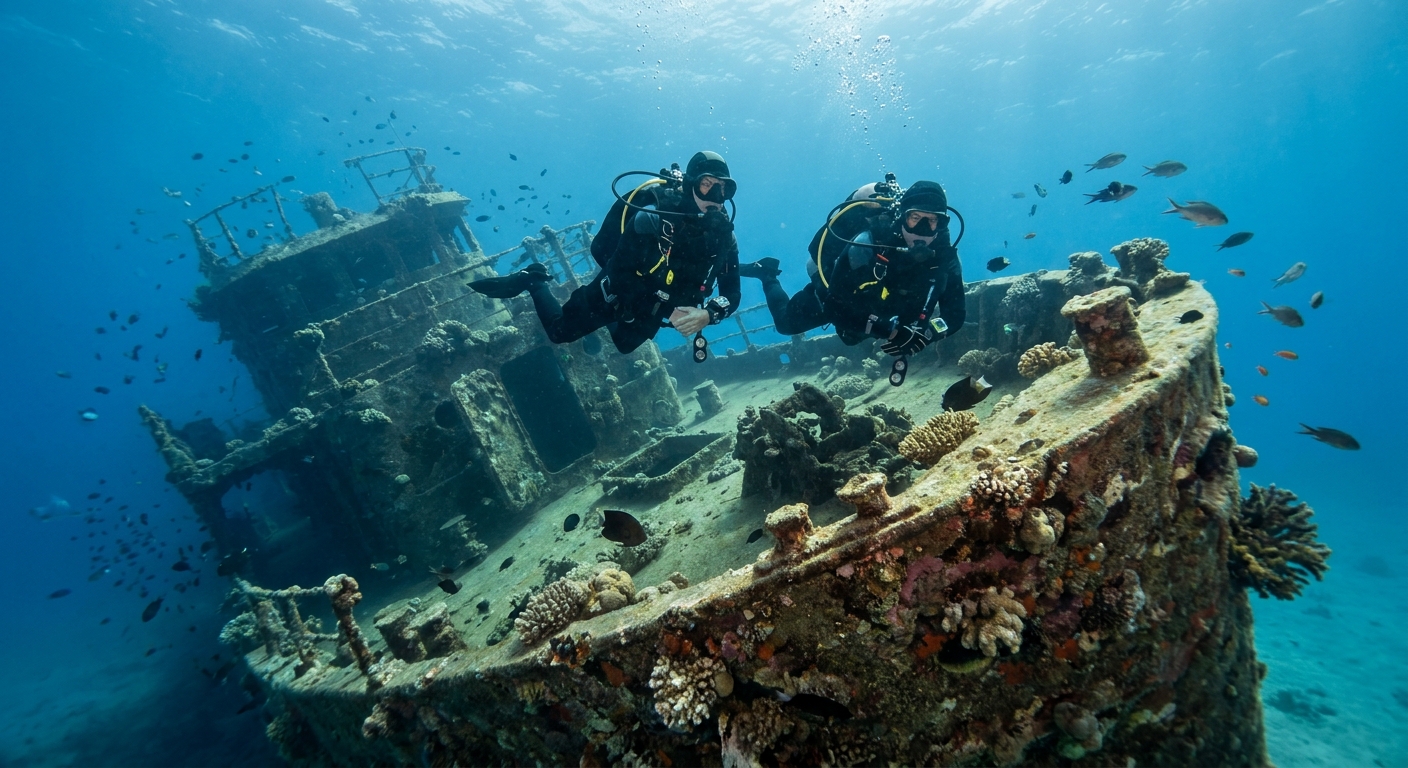
Wreck diving trips for advanced divers in Hurghada in 2026 mean four real sites — Abu Nuhas, Salem Express, SS Thistlegorm, and Rosalie Moller — each demanding a different logbook, a different nitrogen budget, and a different level of respect for depth.
- Abu Nuhas is the safe pick for wreck diving Hurghada advanced trips — four wrecks, 18-27m, buy it.
- Salem Express sits at 30m and carries a no-penetration rule most operators enforce in 2026 — consider it, not for thrill-seekers.
- SS Thistlegorm needs 50+ logged dives and a 5am liveaboard departure from Hurghada — buy it if you have the hours.
- Rosalie Moller drops to 39m with strong current — skip it under 75 logged dives.
Why this matters
Hurghada gets marketed as a beginner reef town, and most of its dive boats are built for that crowd. Advanced wreck sites sit further out, run deeper, and punish divers who show up with an Open Water card and 12 dives. The gap between "certified" and "ready for a wreck at 30m with current" is exactly where trips go wrong — missed decompression stops, panicked ascents, or a boat that turns back because half the group can't handle the swell.
Who this is for
This guide is for divers holding at least a PADI Advanced Open Water certification (or equivalent) with 30+ logged dives, comfortable at depths past 18m, and looking for wreck diving Hurghada advanced trips rather than a reef drift with a wreck bolted on. If you're newer to the sport, certified divers in Hurghada trips cover the reef-and-shallow-wreck combos that build the hours you'll need before Salem Express or Thistlegorm make sense.
What to look for in wreck diving trips for advanced divers
Minimum certification and dive count enforced at booking
Any operator that lets you book Thistlegorm or Rosalie Moller without checking your logbook is a red flag, not a convenience. Real wreck operators ask for certification level and dive count before confirming, because a diver who panics at 30m endangers the whole group's air and ascent schedule.
Depth and bottom time matched to the site
Salem Express and Thistlegorm both sit near 30m, which limits bottom time to roughly 20-25 minutes on air before you're into deco territory. Rosalie Moller runs deeper at 39m, cutting usable time further. A trip that promises 45 minutes at those depths is either running nitrox or cutting corners on your safety stop.
Current strength and surface conditions on the day
Abu Nuhas earned the nickname "Ships' Graveyard" because of currents strong enough to have wrecked four vessels in the same patch of reef. Wind direction changes daily in the Red Sea, and a wreck that's calm on Tuesday can run a 1-knot current on Thursday — ask the operator how they check conditions the morning of, not the week before.
Boat type: day boat versus liveaboard
Thistlegorm sits far enough from Hurghada that most day-boat trips involve a 5am departure and a 2-3 hour crossing each way, eating into your dive time. A liveaboard covering 2-4 nights gets you two dives on the wreck instead of one rushed one — worth the extra cost if Thistlegorm is the reason you're booking.
Guide-to-diver ratio on technical sites
Wreck penetration and deep profiles call for tighter groups. A 1:4 guide ratio is standard for reef trips but too loose for Rosalie Moller or the interior of Giannis D at Abu Nuhas — look for 1:2 or private guiding on anything past 25m.
Nitrox availability and pricing
Enriched air extends bottom time at depth and cuts nitrogen loading, which matters most on Salem Express and Thistlegorm. If nitrox isn't offered or costs more than a token add-on fee, that operator isn't set up for repeat wreck diving — night diving trips for experienced divers run by the same standard, so check both against nitrox access before booking either.
Check wreck trip availability
Confirm dates, depth, and boat type before you book — clear price, no hidden fees.
Top picks: the wrecks worth your logbook
Abu Nuhas — the safe pick. Four wrecks in one reef system (Giannis D, Chrisoula K, Carnatic, Kimon M) spread across 5-27m, so a single day covers shallow and deep profiles without a liveaboard. One dive on Giannis D's collapsed stern at 18m is enough to see why this site tops most Red Sea wreck lists in 2026. Verdict: Buy.
Salem Express — the sober pick. This 1991 ferry wreck lies on its side at 30m near Safaga, close enough to Hurghada for a day trip. Most operators run a strict no-penetration, no-artifact-touching policy out of respect for the site, and you should book with one that enforces it. Verdict: Consider — go for the history and the exterior swim-through, not for thrills.
SS Thistlegorm — the bucket-list pick. A WWII supply ship sitting at 30m, still loaded with motorcycles, trucks, and rifle crates, reachable from Hurghada by liveaboard or a long day-boat crossing. Operators generally want 50+ logged dives before booking you on this one, and the current at the bow can run strong on exposed days. Verdict: Buy if you've got the hours and the time for a multi-day trip.
Rosalie Moller — the wildcard. Often paired with Thistlegorm on the same liveaboard itinerary, this collier sits deeper at 39m with less current protection and far fewer divers per year. It rewards divers who want a wreck without the crowds, but the depth and lower visibility push it past what most advanced-card divers should attempt without extra dives logged first. Verdict: Consider above 75 dives, Skip below that.
What to avoid
- "Wreck experience" add-ons on shallow reef trips. A 5-minute swim past a sunken barge at 8m is not wreck diving — it's a photo op bolted onto a snorkel-and-reef itinerary.
- Day boats claiming a full Thistlegorm dive without a liveaboard. The 2-3 hour crossing each way leaves barely enough daylight for one rushed dive; two proper dives need an overnight stay on the water.
- Operators that skip the logbook check. If nobody asks your certification level or dive count before confirming a 30m wreck slot, that's a sign the crew isn't tracking who's actually ready for the site.
Verdict comparison
| Wreck | Max depth | Access from Hurghada | Min. experience | Verdict |
|---|---|---|---|---|
| Abu Nuhas | 5-27m | Day boat | Advanced Open Water | Buy |
| Salem Express | 30m | Day boat | Advanced Open Water + 40 dives | Consider |
| SS Thistlegorm | 30m | Liveaboard or long day trip | 50+ dives | Buy |
| Rosalie Moller | 39m | Liveaboard | 75+ dives | Consider/Skip |
FAQ
What certification do you need for wreck diving in Hurghada?
Most Hurghada operators require at least PADI Advanced Open Water and 30-50 logged dives for sites like Salem Express and Thistlegorm in 2026. Deeper wrecks like Rosalie Moller push that requirement to 75 dives or more.
How deep is the Thistlegorm wreck from Hurghada?
The SS Thistlegorm sits at roughly 30m at its deepest, with the main deck around 16-18m. Bottom time on air runs about 20-25 minutes before decompression limits kick in.
Is Salem Express open to divers?
Yes, but most operators enforce a strict no-penetration and no-touching policy out of respect for the 1991 sinking. Exterior swim-throughs at 30m are standard; interior access is generally off-limits.
Can beginners see wrecks in Hurghada?
Shallow sections of Abu Nuhas can work for newer divers under close guiding, but Salem Express, Thistlegorm, and Rosalie Moller are advanced-only sites due to depth and current.
Do you need nitrox for Red Sea wreck diving?
Nitrox isn't mandatory but extends bottom time and cuts nitrogen loading at 25-30m sites. Serious wreck divers in 2026 book it as standard on Thistlegorm and Salem Express trips.
How many days does a Thistlegorm trip take from Hurghada?
A day-boat crossing takes 2-3 hours each way with time for one dive, while a liveaboard covering 2-4 nights allows two full dives on the wreck plus reef stops along the way.
Which Hurghada wreck has the least current?
Abu Nuhas offers calmer conditions on most days compared to Salem Express or Thistlegorm, though currents at Abu Nuhas can still run strong depending on wind — hence the nickname Ships' Graveyard.
One last thing
Abu Nuhas got its "Ships' Graveyard" nickname because four separate vessels wrecked on the same reef between 1978 and 1980 — not from one storm, but from ships following the same bad line past the same current in different years. That's the pattern advanced divers should read into every wreck briefing in 2026: the current didn't stop being dangerous just because the last boat made it through.