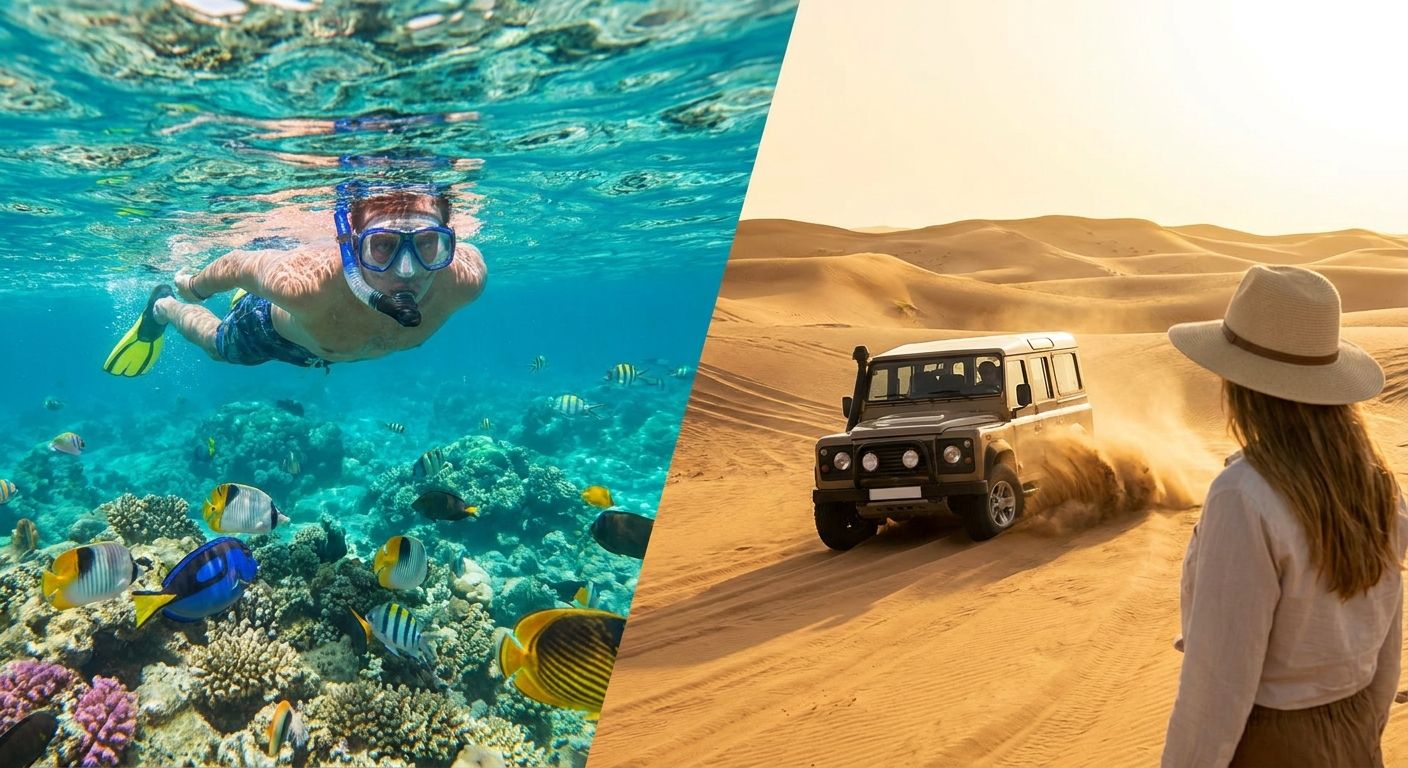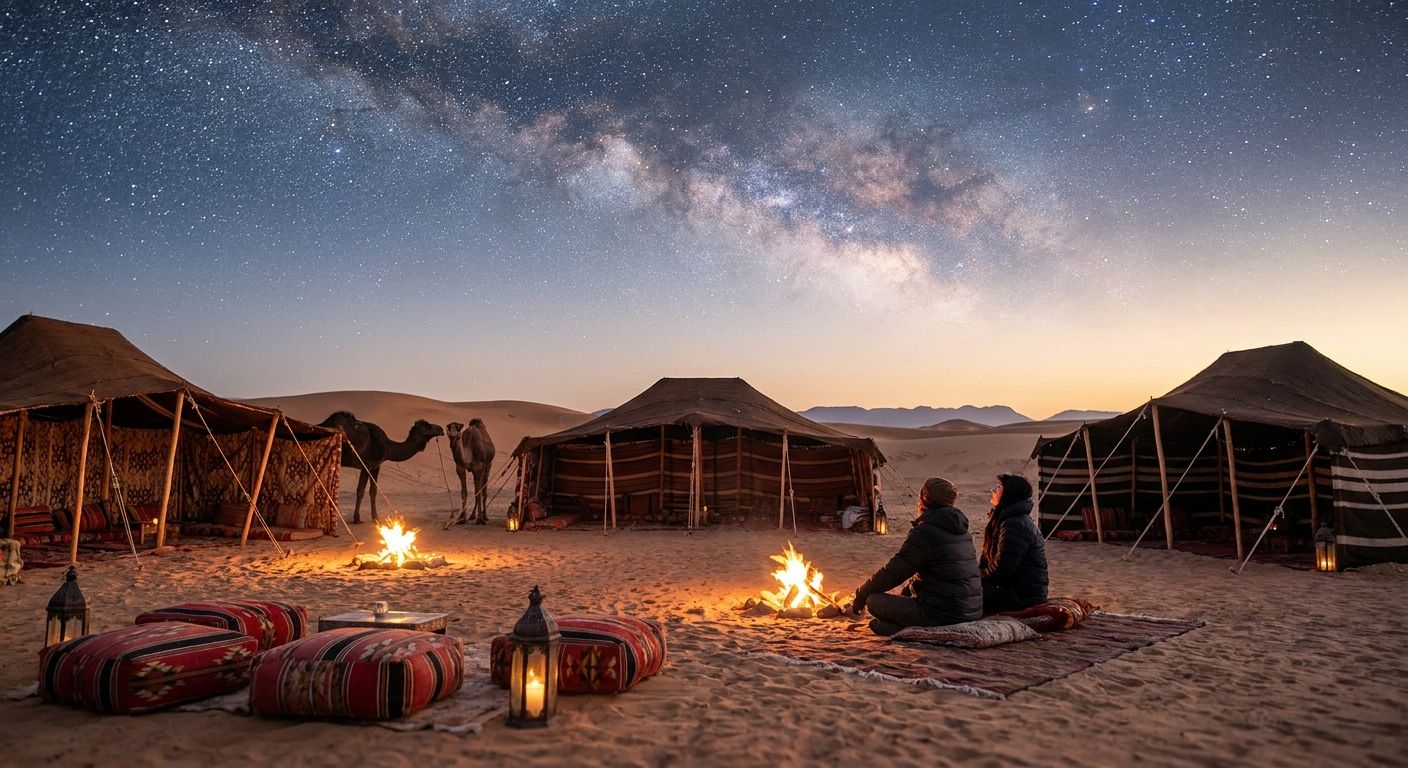
An overnight Bedouin desert camp outside Hurghada trades a hotel balcony for the darkest sky within reach of the Red Sea coast — pick the right one and the Milky Way shows up without a telescope.
- Daily Red Sea's overnight bedouin desert camp near Hurghada wins for stargazers who want real darkness. Buy.
- Camps under 20km from the coast still catch Hurghada's light dome — skip those for serious viewing.
- New moon weeks in 2026 give the darkest skies; full moon weeks wash out faint stars and the Milky Way band.
- A basic tripod and wide-angle lens beat binoculars for photographing the desert sky over camp.
Why this matters
Hurghada's beachfront strip runs bright most nights of the year, and that glow reaches several kilometers inland before the sky turns genuinely dark. Anyone searching for a bedouin desert camp overnight Hurghada trip is usually chasing one thing: a sky the coast can't deliver. Get the location and format wrong and you'll spend an overnight camp squinting at a hazy horizon instead of a sky full of stars.
The difference between a good stargazing camp and a mediocre one in 2026 isn't the tent or the dinner — it's distance from artificial light, and whether the trip is actually built to run overnight rather than repackaged from a sunset excursion. Daily Red Sea runs both formats out of Hurghada, and the distinction matters more than most operators admit upfront.
Who this is for
This guide is for travelers who want to see the Milky Way with their own eyes, not just a campfire photo for Instagram. It's built for people who don't mind a 4x4 ride over sand, a night away from air conditioning, and a 5am wake-up if the plan includes sunrise over the dunes. If your idea of a good night is a heated pool and room service, an overnight bedouin desert camp isn't the trip — a shorter sunset safari is.
What to look for in a Bedouin desert camp for stargazers
Distance from Hurghada's light dome
Anything inside roughly 20 km of the coastal strip still catches ambient glow on the horizon, which flattens the fainter half of the visible star field. Ask the operator directly how far the overnight camp sits from the nearest resort lighting — a vague answer is a red flag. The camps that matter for stargazing sit well past the last hotel cluster, deep enough that the horizon actually goes black.
Overnight structure, not a sunset add-on
A lot of "overnight desert camp" listings are sunset safaris with a late dinner tacked on, returning guests to Hurghada by 10pm. A true overnight stay means sleeping at camp and driving back the next morning, which is the only format that gets you into the 11pm-to-3am window when the sky is darkest and the Milky Way core is highest.
A guide who actually points out constellations
The best camps pair the stay with a guide who can point out Orion, the Southern Cross window, or a passing meteor without checking a phone app first. That local knowledge is what separates a stargazing experience from just sitting outside in the dark.
Sleeping setup that survives desert nights
Desert nights swing cold even when the day hits 30°C, so a camp needs proper bedding and blankets, not a thin mat on sand. Ask what the camp provides versus what you need to bring — this single detail causes more complaints than anything else on overnight trips.
Fixed departure and return times
A camp worth booking gives you a specific pickup window and a specific return time the next morning, not "early" and "whenever." Vague scheduling around an overnight stay usually means the operator is juggling multiple groups and stargazing time gets cut short.
Group size
Smaller groups mean quieter camps, less chatter drowning out the guide, and more room around the fire to actually look up. Anything over 20-25 people at one site starts to feel like a festival, not a stargazing night.
Top picks for an overnight Bedouin desert camp
The flagship — Best Stargazing Desert Tours in Hurghada. Built specifically around a dedicated dark-sky stop past the 20 km buffer, with groups typically capped around 12 people and a guide trained to walk through visible constellations. This is the trip built for the search itself — Buy.
The photographer's pick — Night Photography Desert Safari in Hurghada. The guide holds the group at the dark-sky stop for 90-plus minutes specifically to allow long-exposure setup, rather than rushing everyone back to the fire. Pack for grit, not glamour — sand gets into everything within the first 20 minutes at camp, and a padded backpack with a flimsy zipper won't survive three overnight trips. A proper camera bag for stargazing needs a rigid base, sealed zippers, and room for a compact tripod, the same build quality serious travel photographers demand from any bag that gets checked at Hurghada airport and thrown into a 4x4 an hour later. Buy if you're shooting the sky, not just watching it.
The feast-first option — Bedouin Dinner Experience. Starts with a traditional dinner cooked at camp before the overnight stargazing portion begins, which suits groups who want food to be the centerpiece rather than an afterthought. Stargazing here is real but secondary to the meal. Consider if the dinner matters as much as the sky to your group.
The romantic shortcut — Sunset Desert Safari for Couples. A shorter format that ends with an early return, so it's not a true overnight stay and the darkest hours are missed entirely. Good for couples with an early flight the next day, wrong for anyone chasing the Milky Way core. Consider only if a full overnight doesn't fit your schedule.
The family option — Desert Safari for Families with Young Kids. Runs on an earlier bedtime schedule so younger travelers aren't up past 10pm, which means the deepest dark-sky window gets skipped for the group's sake. Skip for serious stargazers, Consider for a family trip where the camp experience matters more than the astronomy.
What to avoid
- Sunset trips marketed as "overnight." If the itinerary shows a return time before 10pm, it isn't an overnight camp, no matter what the listing title says.
- Camps pitched inside a resort perimeter. Some "desert camps" sit close enough to a hotel fence that you can still see pool lighting from the dunes — that defeats the entire point of driving out for stargazing.
- Operators with no fixed Bedouin family running the site. A camp that changes location every week or subcontracts to whoever's cheapest that night usually skips the guide knowledge that makes the stargazing portion worth the trip.
Verdict comparison
| Pick | Distance from coast | Format | Group size | Verdict |
|---|---|---|---|---|
| Best Stargazing Desert Tours | 20+ km | True overnight | ~12 | Buy |
| Night Photography Desert Safari | 20+ km | True overnight | Small group | Buy |
| Bedouin Dinner Experience | Moderate | Overnight, dinner-led | Medium | Consider |
| Sunset Desert Safari for Couples | Moderate | Sunset only | Small group | Consider |
| Desert Safari for Families | Moderate | Overnight, early bedtime | Medium-large | Skip for stargazers |
FAQ
What's the best time of year for a bedouin desert camp overnight in Hurghada?
October through April brings cooler desert nights and clearer air, which makes for sharper stargazing than the peak summer heat. Check the 2026 lunar calendar too — new moon weeks give the darkest skies.
How much does an overnight Bedouin desert camp cost in Hurghada?
Pricing varies by operator and what's included, from transfer and dinner to bedding, so confirm the full breakdown before booking. Ask specifically whether the price covers overnight bedding or just the evening activities.
Is an overnight desert camp safe for solo travelers?
Camps run by an established Bedouin family with a fixed pickup and return schedule are generally a safe overnight option for solo travelers. Confirm the group size and guide presence before booking rather than assuming.
Do you need a telescope to stargaze in the Hurghada desert?
No — a camp positioned past Hurghada's coastal light dome shows the Milky Way with the naked eye on a clear, moonless night. A telescope adds detail on planets and star clusters but isn't required for the main experience.
How far is a real stargazing camp from Hurghada hotels?
Camps built for stargazing sit at least 20 km from the coastal strip, roughly a 45-minute drive from most Hurghada hotels. Anything closer still shows ambient glow on the horizon.
What's the difference between a sunset safari and an overnight camp?
A sunset safari returns to Hurghada by evening and misses the darkest viewing window between 11pm and 3am. An overnight camp keeps you at the site through that window and back the next morning.
Can beginners see the Milky Way without special equipment?
Yes, on a clear night away from coastal lighting the Milky Way band is visible to the naked eye with no equipment needed. A guide pointing out constellations adds context but isn't required to see it.
What should I pack for an overnight desert stay?
Bring layers for a cold desert night, a headlamp, and a padded bag for any camera or electronics given the sand. Confirm with the operator what bedding is provided so you're not doubling up unnecessarily.
One last thing
August brings the Perseid meteor shower, one of the more visible meteor events of the year, and a desert camp 20-plus kilometers from Hurghada's coastal glow is a far better vantage point for it than any beachfront hotel balcony. Book the overnight format specifically, not the sunset version, if catching a meteor is the actual goal.