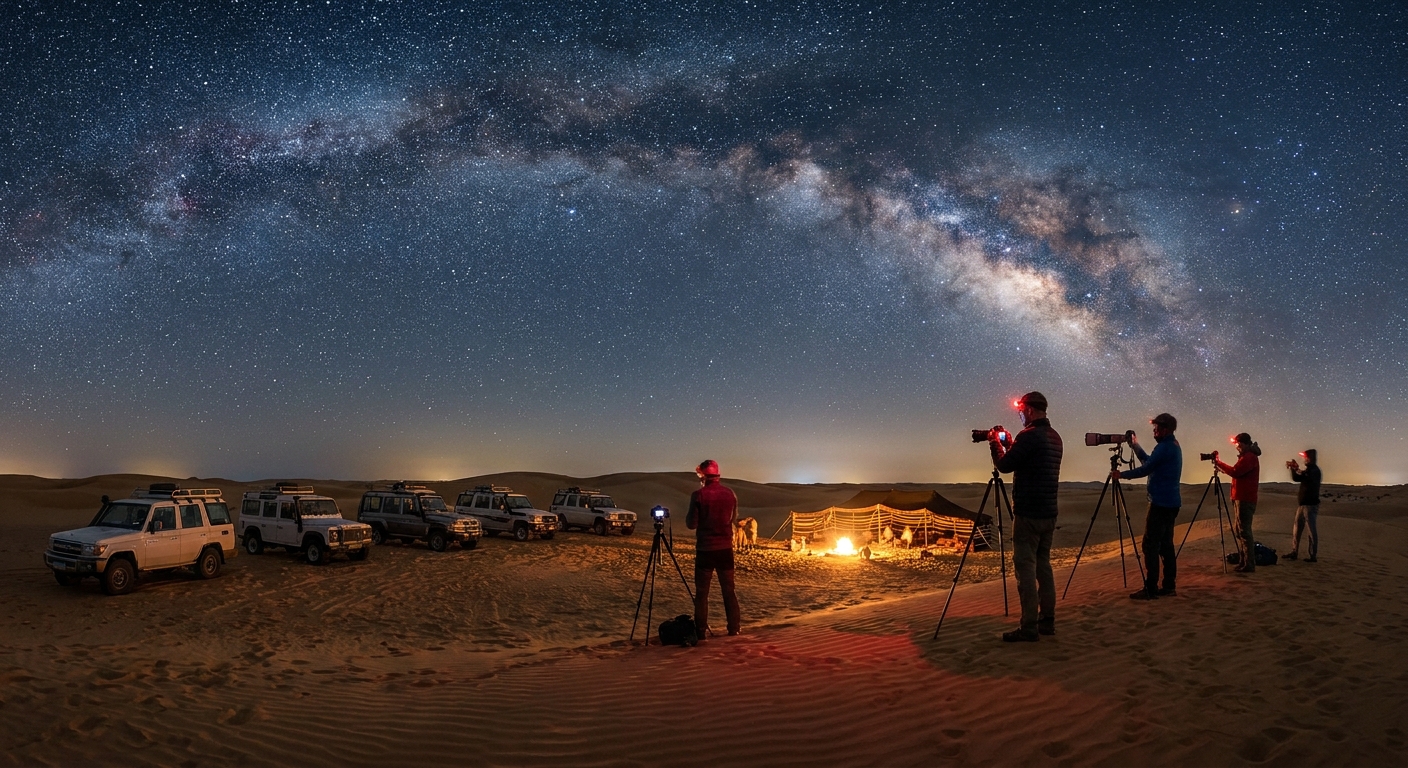
A night desert safari built for photographers needs three things a standard sightseeing tour rarely delivers: real darkness, a stop long enough for a 20-minute exposure, and a guide who won't rush you back to the truck. This guide breaks down what night desert safari stargazing in Hurghada should look like for photographers in 2026, and which tour formats actually deliver dark sky over dune-convoy noise.
- Night desert safari stargazing Hurghada works best as a private or small-group booking, not a large convoy tour.
- A 20-minute stationary stop beats five rushed photo breaks for star trail and Milky Way shots.
- Sunset Desert Safari for Couples doubles as a photographer entry point with golden hour plus early stars. Consider.
- Large group desert safaris run on a fixed schedule that kills long-exposure shots in 2026. Skip for serious photography.
- A tripod, remote shutter, and 24mm-or-wider lens matter more than camera body for Eastern Desert night shots.
Why this matters
Hurghada's hotel strip sits under enough ambient glow to wash out anything past a faint star. Drive 30 to 45 minutes into the Eastern Desert and the sky drops several classes on the Bortle scale on a clear night, dark enough to frame the Milky Way core with a basic tripod setup.
Daily Red Sea runs desert safaris out of Hurghada, and the gap between a shot worth keeping and a blurry dune photo usually comes down to how the tour is structured, not the camera in your bag. A 2026 stargazing trip needs one fixed, unhurried stop, not a 15-minute photo break wedged between quad bike laps.
Who this is for
This guide is for photographers chasing star trails, Milky Way frames, or long-exposure dune shots, not a quick phone snap of a campfire. You're bringing at least a tripod, you know your camera's manual mode, and you'd rather sit still for 20 minutes than bounce between five stops. Group-tour travelers who just want a five-minute selfie under the stars should book a standard sunset safari instead.
What to look for in a night desert safari for photographers
Distance from city light pollution
Ask how far the vehicle actually drives past the last streetlight. A camp visible from the Hurghada coastal road still carries sky glow that flattens contrast in long exposures. The farther the stop sits from the strip, the deeper the black behind the stars.
Stop length, not stop count
A tour that hits four scenic points in two hours is built for sightseeing, not shooting. Photographers need one 20-to-30-minute stationary window per location minimum, since star trail exposures alone can run 15 minutes or longer.
Moon phase and departure timing
A full moon lights the desert floor enough to kill faint stars in the frame. Check the 2026 lunar calendar before booking and aim for a new-moon week if the Milky Way core is the goal, or a crescent night if you want some foreground detail.
Vehicle access to open dune, not just camp
Some night safaris park at a fixed Bedouin camp with tents and lighting nearby, which reintroduces light pollution into the frame. Confirm the tour includes a separate open-dune stop away from any camp lighting.
Guide patience with tripod setups
A guide used to rushing groups back for dinner service will hover during setup. Ask directly whether the operator has handled photographer bookings before, or whether the itinerary is built around dining and entertainment instead.
Cold-weather and gear prep
Desert nights drop hard after sunset even in summer months. Sand and dust get into gear fast during transfers, so a padded bag and a spare lens cloth matter as much as a jacket.
Top picks for photographers
The golden hour double-dip
The Sunset Desert Safari for Couples departs before sunset and covers both golden-hour dunes and the first hour of stars in one trip. It's the only listed format that gives you two lighting conditions without a separate late-night booking. The tradeoff is timing: the Milky Way core usually clears the horizon later in the evening depending on season, so this pick works better for star-field shots than a full star-trail sequence. Verdict: Consider if you want sunset color plus a taste of dark sky in one outing.
The private night session
A private evening booking through Daily Red Sea with no fixed group schedule is the strongest setup for photographers who want the full 20-to-30-minute stationary window at a dark stop. You control the pace, the guide isn't managing ten other guests, and the vehicle can wait while you reposition for a second exposure. Verdict: Buy if star trails or Milky Way panoramas are the actual goal.
The large convoy safari
The Desert Safari for Large Tour Groups moves fast by design, with a photo stop typically capped around 15 to 20 minutes across the whole group. That's barely enough time for one person to set a tripod, let alone run a multi-frame star trail sequence. Verdict: Skip for serious night photography, book it only if you're traveling with a mixed group that isn't shooting.
What to avoid
- Quad biking safaris at night look adventurous but the engine noise and ground vibration during transit rule out any handheld or tripod shot along the route.
- Family-focused desert safaris with young kids run with flashlights, camp lighting, and a shorter overall stop, all of which work against dark-sky photography.
- BBQ-and-show desert evenings are built around entertainment lighting at the camp, which spills into any wide shot of the sky.
Verdict comparison
| Safari type | Group size | Photo stop length | Light pollution | 2026 Verdict |
|---|---|---|---|---|
| Private night desert safari | 1-4 | 20-30 min | Low | Buy |
| Sunset Desert Safari for Couples | 2 | 15-20 min | Low-medium | Consider |
| Large group desert safari | 10+ | 15-20 min total | Medium | Skip |
FAQ
What's the best time of night for desert safari stargazing in Hurghada?
The window right after full dark, roughly 90 minutes after sunset, gives the clearest sky before late-night haze builds near the coast. Aim for a new-moon week in 2026 for the deepest black background.
Is a private night desert safari better than a group tour for photography?
Yes, a private booking gives photographers a full stationary window instead of a shared 15-minute stop. Group convoys move on a fixed schedule that doesn't account for tripod setup time.
How dark does it get outside Hurghada city limits?
A drive of 30 to 45 minutes into the Eastern Desert typically clears most of the coastal light glow on a clear night. That distance is usually enough for the Milky Way core to show up in a basic long exposure.
What camera settings work for Milky Way shots in the Eastern Desert?
A wide lens around 24mm or wider, ISO 1600 to 3200, and a 15-to-20-second exposure is a workable starting point. Adjust exposure time downward if star trailing appears at your focal length.
Does moon phase affect a night desert safari stargazing trip?
Yes, a full moon lights the desert floor enough to fade fainter stars out of the frame. Booking around a new-moon or thin-crescent night in 2026 keeps the sky darker for star photography.
How cold does the desert get at night in Hurghada?
Temperatures drop noticeably after sunset even during summer months, more than most visitors expect from a desert climate. A light jacket and a dust cover for gear are worth packing regardless of season.
Can beginners join a night desert safari for stargazing?
Yes, beginners can join as long as they bring a tripod and know their camera's manual mode before arriving. The tour itself doesn't require experience, but a rushed group stop makes learning on-site difficult.
How much does a night desert safari cost in Hurghada?
Pricing varies by group size, vehicle type, and whether the booking is private or shared, so check current rates directly before booking. Private sessions generally run higher than convoy-style group tours.
One last thing
The single biggest photo-killer on a night desert safari isn't gear, it's the itinerary. A tour that lists "stargazing stop" as one line item among six activities almost never budgets the 20-plus stationary minutes a star trail needs. Ask for the stop duration before you book, not after you're standing in the dark with the truck engine already running.