Kite surfing lessons for beginners in Hurghada can put you riding independently inside a week — or waste three days on the wrong beach — depending entirely on the launch spot and the course structure you book. This guide breaks down what actually matters for a first kite course near Hurghada in 2026, where beginners actually learn, and which options to skip.
- El Gouna's lagoon, 25 km north of Hurghada, is the top pick for kite surfing lessons near Hurghada in 2026 — flat, waist-deep water. Book it.
- A real beginner course runs 9-12 hours over three days under IKO or VDWS standards; skip any taster session under three hours.
- Wind season runs April through November, with the steadiest side-shore thermals from June to September.
- Skip open-sea launches directly off central Hurghada beaches for your first session — current runs strong past the reef line.
- Pair lessons with a private transfer and a rest-day excursion; kite schools rarely bundle either.
Why the launch spot matters more than the instructor
Hurghada's coastline is reef-lined and shallow in patches, and that's exactly why beginner kite surfing here splits hard between good options and bad ones. A flat lagoon with waist-deep water lets a new rider crash dozens of times an hour without touching coral or fighting a current. An open beach launch does the opposite — wind gusts funnel between headlands, and a downed kite drifts toward the reef fast.
Most travelers booking kite lessons around Hurghada are also stacking other days with boat trips, diving, or a desert run. Daily Red Sea covers those other days so the kite school can stay focused purely on wind and water. The two businesses solve different problems: one teaches you to ride, the other handles everything else around it.
Who this guide is for
This is written for travelers with zero kiteboarding experience booking a Hurghada trip in 2026 who want real riding time, not a photo-op afternoon. It assumes you can swim comfortably, you're fine in open water without a life vest for short stretches, and you've blocked at least three consecutive days — kiteboarding isn't a one-afternoon skill, no matter what a beach flyer promises. If you've kited before and just want the spot rundown, skip straight to the comparison table below.
What to look for in kite surfing lessons for beginners
Wind window and season
Hurghada's Red Sea corridor carries reliable side-shore wind from April through November, with June through September delivering the steadiest 15-22 knot thermals. Book outside that window and you're gambling on a light-wind day that turns into two hours of waiting on the beach instead of riding.
IKO or VDWS certification
Ask which certification body the school follows — IKO (International Kiteboarding Organization) and VDWS are the two standards used across Egypt's kite centers. Certification means a structured curriculum with a leash-check routine, a radio-linked safety boat, and a syllabus built toward independent riding, not just an afternoon of body-dragging.
Flat-water lagoon vs open sea launch
A shallow, enclosed lagoon like El Gouna's is built for falling down safely — you stand up, sort your lines, and relaunch without swimming anywhere. An open beach launch near central Hurghada demands more water confidence from day one because the bottom drops off and current runs along the reef edge.
Beginner-sized gear and student ratio
Beginner kites for light-to-mid wind typically run 9-14 square meters, sized to the rider's weight and the day's wind speed. A school without a range of kite sizes will put you on the wrong gear the moment the wind shifts. Ask for a 1-to-1 or 2-to-1 student-to-instructor ratio for the first two days; anything looser means you spend lesson time watching, not riding.
Course length and structure
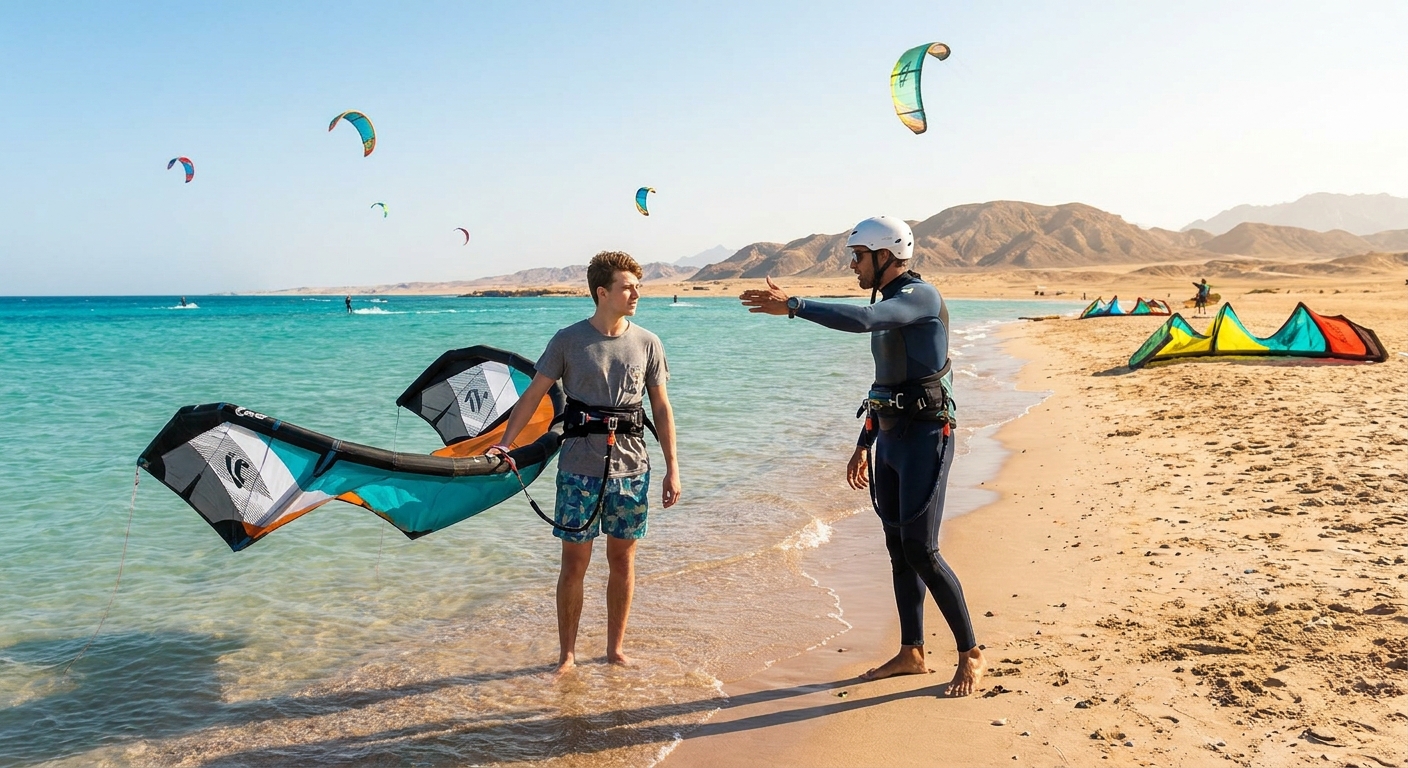
A real beginner package runs 9 to 12 hours spread across three days: kite control on land, then body-dragging in the water, then board-and-kite combined. Compress that into a single 3-hour taster and you'll get a fun hour of flying a kite with zero chance of standing up on the board.
Safety boat and radio backup
Confirm a chase boat or jet ski is actually on the water during your lesson, not parked on standby at the shop. Wind gusting past 25 knots can drag an unpracticed rider well offshore in under a minute — a radio-linked boat is the difference between a quick pickup and a long swim back.
Book your Hurghada airport transfer
Arrange pickup before your first kite lesson so gear and timing line up.
Where beginners actually learn to kite surf near Hurghada
El Gouna lagoon — the safe pick. El Gouna sits about 25 km north of Hurghada, and its inner lagoon stays waist-deep for a wide stretch, which is why most IKO-certified schools on this coast base their beginner program there. Wind funnels cleanly across the flat water most afternoons from June to September, and a fall means standing up, not swimming. Verdict: Book — it's the standard beginner venue on this stretch of coast in 2026.
Soma Bay — the open-water upgrade. Roughly 45 km south of Hurghada, Soma Bay has more room and slightly stronger wind exposure than El Gouna's lagoon, which suits a rider who's already cleared a few days of lagoon lessons. It's less forgiving for a true first-timer because the bay opens onto deeper water faster than a closed lagoon does. Verdict: Consider — good for day three or four, not day one.
Hurghada central beaches — convenient but crowded. Launching straight off central Hurghada saves the drive, but boat traffic and closer reef lines mean instructors keep beginner water sessions short and tightly supervised. It's fine for an hour of land-based kite control; it's not where you want your first time on the board. Verdict: Consider for land drills only, skip for water time.
Safaga — the wind-reliability pick. About an hour south of Hurghada, Safaga gets some of the most consistent wind on this coast thanks to a wider funnel between the hills and the sea, with fewer flat-lull days than Hurghada proper. The longer transfer only pays off if you're staying three or more days specifically to kite. Verdict: Book if wind reliability matters more to you than travel time.
Getting between these spots and your hotel is worth planning ahead — a private transfer from Hurghada airport sets a fixed pickup time so you're not negotiating a taxi at 6 a.m. before the wind picks up.
What to avoid when booking kite surfing lessons in Hurghada
Single-session "taster" packages under 3 hours. They're fun, but they skip body-dragging and self-rescue — the two skills that keep you safe once you're riding without an instructor's hand on the bar.
Open-sea launches for your first session. A beach that looks calm at 9 a.m. often builds to 20+ knots by early afternoon, and without lagoon experience first, that shift catches beginners mid-lesson.
Off-season bookings outside April-November. Light or inconsistent wind between December and March means long waits on the beach and a real chance your lesson gets rescheduled outright.
Kite surfing lesson comparison for Hurghada beginners in 2026
| Spot | Distance from Hurghada | Best for | Verdict |
|---|---|---|---|
| El Gouna lagoon | ~25 km north | True first-timers | Book |
| Soma Bay | ~45 km south | Riders past day 2 | Consider |
| Hurghada central beaches | 0 km | Land drills only | Consider (land only) |
| Safaga | ~1 hour south | Wind reliability | Book |
Building the rest of your Hurghada trip around the wind
Kiteboarding eats a full afternoon of energy, so plan lighter mornings around it rather than stacking two demanding activities in one day. A desert safari in Hurghada works well as an early-morning add-on before the wind builds, and a sunset cruise in Hurghada is an easy way to wind down after three days of falling off a board. Daily Red Sea runs both alongside its snorkeling and boat-trip excursions, so the logistics side of a 2026 Hurghada trip stays in one place while the kite school handles the water time.
FAQ
What's the best spot for kite surfing lessons in Hurghada?
El Gouna's lagoon, about 25 km north of Hurghada, is the best spot for beginner kite surfing lessons in 2026 because the water stays flat and waist-deep. Most certified schools on this coast base their beginner program there for that reason.
How long does it take to learn kite surfing as a beginner?
A typical beginner course runs 9 to 12 hours spread over three days under IKO or VDWS standards. That's usually enough to reach independent riding, not just body-dragging.
Is Hurghada good for beginner kite surfers?
Yes, given the reliable wind season from April through November, but central beach launches aren't ideal for a first session. Lagoon sites like El Gouna are the better starting point.
What's the best time of year for kite surfing near Hurghada?
June through September delivers the steadiest 15-22 knot side-shore wind, though the broader season runs April through November. December through March is unreliable for consistent lessons.
Do I need to be a strong swimmer to take kite surfing lessons?
You need to be comfortable swimming in open water without a life vest for short stretches. Most schools require basic swimming ability before starting the water phase of the course.
Is kite surfing dangerous for beginners?
The risk comes mainly from open-water launches and skipping safety drills, not from the sport itself. A certified school with a radio-linked chase boat cuts that risk substantially.
Can I combine kite surfing lessons with other Hurghada excursions?
Yes, most travelers pair lessons with lighter rest-day activities like a desert safari or a boat trip since kiteboarding is physically demanding. Scheduling those on non-lesson mornings works best.
How much wind do you need for a beginner kite lesson?
Schools typically run beginner sessions in the 12-22 knot range. Days below that get rescheduled since there isn't enough power to launch beginner-sized kites.
One last thing
Most first-timers spend more lesson time walking the kite on land than actually riding — land-based kite control alone can eat half of day one, and that's normal, not a sign of a bad instructor. The riders who skip that step almost always end up re-learning it in the water the hard way, usually with a tangled line and a longer swim back to shore.